Learn how Gaggle supports K–12 student safety and productivity in near real time using Amazon Nova.

Gaggle set out to build an AI-driven web filter for K–12 districts that could analyze and categorize the safety of millions of web pages in near real time. To power this capability in live classroom environments, the company required a multimodal large language model (LLM) that delivered fast responses while remaining cost-effective.
Using generative AI from Amazon Web Services (AWS), Gaggle developed its real-time Web Filter to provide instant classification at scale. The fully automated solution improves threat detection by 287 percent compared to traditional web filters, reduces manual workloads for IT teams, and preserves access to educational content—all while aligning with district budget requirements.
 Gaggle wanted to better protect K–12 students using AI to analyze and categorize website content in near real time. With around 250,000 new sites going live each day and millions of videos uploaded to YouTube, traditional blocklist-based web filters cannot handle the volume. In addition, broad filtering methods can affect student learning by blocking entire sites, even when they contain legitimate educational content.
As Gaggle began developing its real-time Web Filter, a tool designed to analyze and classify individual web pages and media in real time rather than relying on static blocklists, the company identified several technical and business challenges. Enterprise-scale LLMs increased inference costs and offered capabilities beyond what the real-time classification use case required. Meanwhile, less advanced models lacked the responsiveness needed for real-time filtering in classroom environments. To make the filter viable, Gaggle needed a cost-effective generative AI solution that could scale to handle millions of real-time classification requests while maintaining the speed students and teachers expect.
 While Gaggle had already adopted Amazon SageMaker and Amazon Bedrock to develop and operate LLMs across its platform, they chose Amazon Nova to support real-time, large-scale content classification. By adding Amazon Nova, the company gained access to multimodal foundation models that delivered the accuracy, responsiveness, and cost control required for web filtering at scale.
Gaggle accelerated development using Amazon Nova’s simplicity and performance with support from AWS AI experts. The Gaggle team built a two-pass decision system combining the speed and scale of Amazon Nova Lite with the higher reasoning power of Amazon Nova Pro.
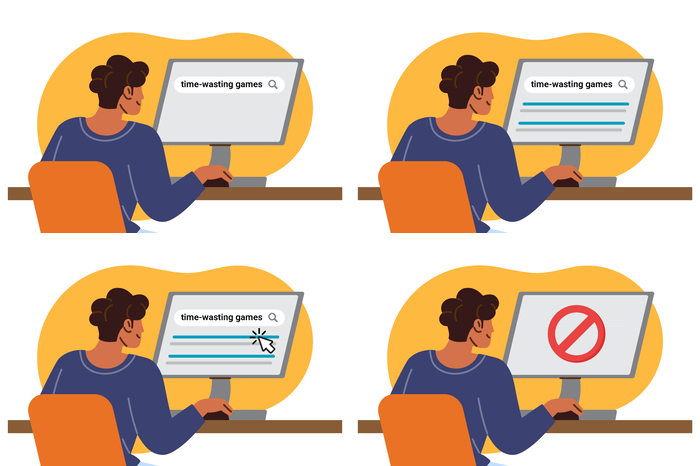
When a student accesses a website, the real-time Web Filter first checks the URL against previously classified pages. If the page has not been classified, the system captures screenshots and text content and submits them to Amazon Nova Lite for real-time analysis. The model classifies the content into categories relevant to K–12 environments and stores the results in Gaggle’s custom categorization database for future retrieval. If Amazon Nova Lite returns an ambiguous result, the system escalates the request to Amazon Nova Pro for deeper reasoning and more detailed analysis.
Justin DeWind, chief technology officer at Gaggle, says, “Amazon Nova delivered great multi-modal accuracy at a competitive per-token cost, and performance could be tuned using an ensemble of prompts with minimal impact on cost or latency.”
 With Gaggle’s real-time Web Filter, K–12 schools gain an automated solution that enhances student safety while preserving access to educational content. Compared with traditional web filters, the AI-driven solution improves threat detection by 287 percent while reducing manual effort for school IT staff.
In the last six months alone, the solution identified approximately 245,000 newly emergent inappropriate websites, including more than 55,000 high-risk sites across categories such as adult content, cyber threats, gambling, violence, and hate speech—content traditional rule-based filters would have struggled to detect at scale.
Furthermore, the filter provides districts with a cost-effective way to stay ahead of evolving online threats, analyzing and classifying millions of pages in real time across new and existing websites. “Gaggle’s real-time Web Filter using Amazon Nova keeps students safe and productive,” says DeWind. “It also warns them when content may be unproductive, encouraging critical thinking and digital citizenship.”
“With Amazon Nova supporting our real-time Web Filter, K–12 districts get an intelligent solution that continuously helps safeguard students in a rapidly evolving digital environment,” DeWind adds.